Snow Blower Buying Guide
Snow blowers provide quick and efficient snow removal. If you live in the snow belt, one of these machines can be a great alternative to shoveling snow.
Because snow blowers are a sizeable investment, you’ll want to do your research prior to making a purchase. This guide can help narrow down your options.
Choosing a Snow Blower
When purchasing a snow thrower, it's important to do your research. However, before you begin evaluating the different models, be sure to ask the right questions to ensure you get the snow thrower that's best for your needs:
How large of an area do I need to clear?
For smaller driveways and only a front sidewalk, a single-stage units can do the job with ease. For driveways over 60 feet, or for corner lots with additional sidewalk area, choose a two- or three-stage unit to handle the job.
What type of terrain will I be working on?
Paved surfaces allow for the use of any unit.
If your surface is gravel, look for at least a two-stage snow thrower. Single stage throwers come in direct contact with the ground, and will throw gravel as well as snow.
Any auger-assisted, push-propelled models are suitable for level surfaces. For more extreme inclines, use tire chains to enhance traction.
What kind of snow do I need to clear?
Electric units perform best in regions with very light, minimal snowfall (up to 3-4").
Single-stage units can handle snowfall in increments of 6-7", and are ideal for regions with moderate snow.
Two-stage throwers are ideal for most regions with average snowfalls (up to 12"), and are compatible with heavy, wet snow, as well as hard-packed snow or ice.
Three-stage units are ideal for regions with consistently heavy snowfall, as they move more heavy, wet snow in less time; however, they do not perform as well as a two-stage thrower when the snowfall is light.
How does the machine handle?
Smaller electric models and single-stage throwers are lighter to push and easier to handle. Two- and three-stage throwers tend to be heavier and require more effort to maneuver.
Types of Snow Blowers
Once you've determined what type of snow blower you'll need, it's time to compare types of machines. Choose between a corded electric snow blower or a single-, two- or three-stage gas snow blower.
| Electric | Single-stage gas | Two-stage gas | Three-stage gas | |
|---|---|---|---|---|
| Snowfall | Under 6 inches | Up to 12 inches | Up to 2 feet | Up to 2 feet |
| Snow Type | Fluffy / Light | Fluffy / Light to Moderate | Wet / Moderate to Heavy | Wet / Moderate to Heavy |
| Terrain Type | Paved | Paved | Paved / Gravel | Paved / Gravel |
| Benefits | Lightweight | Easy to maneuver | Powerful | Handles heavier snow & ice |
Electric Snow Blowers
The smallest model available on the market, electric snow blowers are ideal for clearing smaller areas of less than 100 feet such as patios, porches, walkways and small-to-medium sized driveways. Roughly the size of a walk-behind lawn mower, single-stage electric snow throwers are easy to handle, manage light to moderate snow well, and work best on smooth, paved surfaces. Generally the most economical option, the electric motor eliminates the need for engine maintenance and fueling that their gas-powered counterparts require.
Pros:
• Less noise
• Easy to maneuver
• Economical
• Eco-friendly
Cons:
• Corded distance limitation
• Cannot handle heavy snow
• Cannot throw snow further than 15 feet
Single-Stage Snow Blowers
More powerful than an electric thrower is a gas powered single-stage snow blower. Ideal for mid-sized, paved driveways, these throwers can handle most light to moderate snowfall of less than 8 inches. Designed to use the auger to propel you forward through the snow, these units operate at a single speed, making them easy to operate and handle.
Due to the auger's contact with the ground, single-stage blowers will not work on gravel driveways. Additionally, the lack of drive system provides little pulling power when going uphill. If you have an average sized, level, paved driveway of one to two car lengths, and a typical snowfall is between 6-10 inches, this model is likely a good choice.
Pros:
• More powerful than an electric thrower
• Easy to maneuver
Cons:
• Cannot handle heavy snow
• Cannot throw snow further than 20 feet
• Requires several passes for snow of 12 inches or more
Two-Stage Snow Blowers
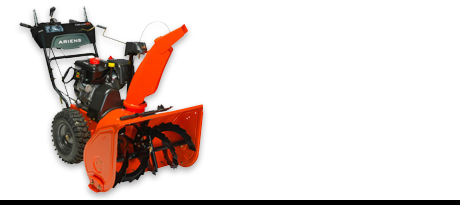
Ideal for most regions that receive a moderate to heavy amount of snow each season is the two-stage snow blower. The most popular type of snow blower available, a two-stage thrower operates with two components. First, the front auger (similar to a single-stage thrower) grabs the snow and pushes it into the center of the front housing. From here, this is where the similarity to a single-stage blower ends. Next, the snow is thrown into a fan, which rotates at about 10x faster than the auger. This fan, called an impeller, propels the snow out the chute, typically at a distance of 30-50 feet.
In addition to throwing the snow further than single-stage blowers, the two-stage machine uses a multi-speed transmission to power the wheels, allowing you to handle deep, heavy snow and large drifts with ease. As well, this thrower style can be used on both paved and gravel surfaces, due to a raised front scraper bar.
Pros:
• Powerful, even in wet, heavy snow
• Wider clearing path requiring fewer passes
• Projects snow over drifts
• Self-propelled
• Works on inclines, gravel, and turf
Cons:
• Heavy and more difficult to maneuver
• Gas engine requires regular maintenance
Three-Stage Snow Blowers
For the ultimate in snow removal power, a three-stage snow blower is optimal for regions that receive consistently heavy snowfall of 8 inches or more. Three-stage throwers operate similarly to a two-stage blower, with the addition of a front accelerator, which powers through dense, built-up snow and ice.
Pros:
• Powers through built up snow and ice
• Wider clearing path requiring fewer passes
• Projects snow over drifts
• Self-propelled
• Works on inclines, gravel, and turf
Cons:
• Under-performs in light to moderate snowfall
• Heavy and more difficult to maneuver
• Gas engine requires regular maintenance
A NOTE ABOUT SNOW BLOWER ENGINES
The evaluation for snow thrower power is measured in CC, which is cubic centimeters. CC is a measurement of swept volume of the pistons inside the cylinders of an engine, often referred to as cylinder displacement.
Keep your snow blower running all season long by fueling your machine properly. Fill the tank using a 93 Octane fuel with no ethanol added (it's bad for small engines, and will wreak havoc on your thrower). Also, add a fuel stabilizer. This will keep your fuel fresh for lengthy spans between snowfalls.
Snow Blower Features
Different models of two- and three-stage snow throwers offer various useful features that may help when making your final purchase decision:
Electric Start: More common in newer models, a machine with electric start is especially handy in extreme temperatures.
Heated Hand Grips: Keep your hands toasty even on the coldest day. While gloves might protect your hands from the wind, heated hand grips will make bigger jobs more tolerable.
Headlights: This functional addition is helpful if you do a lot of snow blowing at night or in the early morning hours. This also keeps you visible to motorists or snow plow operators when tackling the drifts at the edge of your driveway.
Joystick Chute Control: While enhancements have been made to maneuver the direction and angle of the discharge chute, the controls aren't always easy to use when wearing bulky gloves. Joystick controls allow the ease of changing the direction of the chute from the dash.
Folding Handlebars: If space is a concern, or if you plan to transport your machine between locations, consider a model with folding handle bars for more compact storage.
Easy/Auto Turn: Also referred to as freewheel turning, this feature is a must-have on larger snow blowers. This functionality allows the outer wheel to turn faster than the inside wheel for sharp, easy turning, and is typically engaged by a set of triggers under each handlebar.
One-Hand Operation: Rather than requiring two hands to operate both the wheels and the auger, single-handed operation lets you hold down both levers with a single hand. This is ideal when maneuvering turns, giving you a free hand to adjust the chute.
Skid Shoes: Skid shoes are the adjustable metal or composite plates attached to each side of the auger housing to keep the auger from impacting the surface as you're clearing.
MORE RESOURCES